News
LAW SOCIETY
The “Dulanovs” have an owner, and the residents must rely on God’s mercy
The death of several people as a result of a traffic accident due to a technical malfunction is not an ordinary tragedy; rather, in any democratic country, it would become a resonant event. Such an accident leads to the scrutiny of the activities of various companies, enterprises, agencies, ministries, and officials, followed by not only […]
The death of several people as a result of a traffic accident due to a technical malfunction is not an ordinary tragedy; rather, in any democratic country, it would become a resonant event. Such an accident leads to the scrutiny of the activities of various companies, enterprises, agencies, ministries, and officials, followed by not only personnel changes but also structural and legal consequences. That is, when such accidents occur, urgent amendments are made to the legislation of a democratic country. The death of more than two people in one accident is already considered a mass fatality, and all causes and factors must be immediately studied, and the repetition of such an error must be prevented.
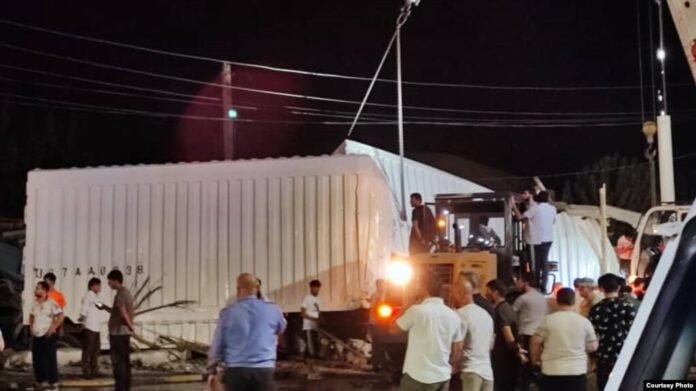
On July 2 of this year, a fatal traffic accident occurred in the village of Elok in the Vahdat district, claiming the lives of eleven people. The cause of this tragic accident was a technical defect, specifically, brake failure of a heavy-duty truck of the “Dulan” brand. As a result, the heavy truck gained enormous speed while descending and collided with two passenger cars traveling on the road. As a result of the tragedy, the passengers and drivers of those two cars died at the scene, totaling 11 people.
The authorities’ reaction to this tragedy, considering the large number of casualties and the frequency of similar incidents, should have been swift and extremely strict. However, the deaths of 11 citizens received less attention than the deaths, according to the authorities themselves, of “large cattle.” For example, the death of 9 cows in Germany due to an accident or falling off a cliff caused a societal resonance that has never been triggered in Tajikistan even by mass fatalities.
If this were the first case of mass fatalities due to a vehicle’s technical malfunction, one might assume that the authorities simply lack experience in such situations and limit themselves to speculation. However, this is not the case. Such tragedies have already become a common occurrence on the country’s roads.
A similar case occurred about three years ago, specifically in March 2023 in Kulob. At that time, exactly the same “Dulan” truck, for the same reason, that is, due to brake failure, descended a slope at high speed and collided with several vehicles and residential houses. As a result, 15 people died. Again, no one was punished, the causes and factors of the tragedy were not studied, and the use of large “Dulan” trucks was not banned, although it should have been. Such vehicles do not meet the conditions of Tajikistan’s roads for several reasons:
- The roads of Tajikistan are mainly mountainous, with a large number of steep descents and ascents, which increases the likelihood of brake failure for any vehicle. However, when a truck is loaded with nearly 40 tons of cargo, and the total weight with the vehicle exceeds 50 tons, the probability of brake failure increases many times over.
- Due to the mountainous terrain and numerous sharp turns, heavy-duty vehicles pose a danger not only to themselves but also to other road users.
- Due to the almost complete lack of use of the railway for cargo transportation, the roads are congested with freight transport, and the presence of such large vehicles creates a danger of traffic jams, accidents, and other incidents.
- In Tajikistan, there are no licensed repair shops that have a license from the manufacturer, and repairs are mainly carried out by self-taught mechanics.
- The majority of cars imported into Tajikistan, both passenger and freight, are old and worn out.
- Due to the lack of proper control and inspection, as well as the possibility of “solving the problem” for a bribe, most drivers transport cargo beyond the established norm to save money or increase their income.
- Most major highways in the country pass through cities and towns, creating a danger to the lives of local residents due to traffic accidents. One of the main reasons for the mass fatalities in traffic accidents in Kulob and Vahdat is precisely that freight trucks pass through populated areas.
Of course, it cannot be said that the authorities of Tajikistan completely ignore all dangers on the roads. For example, it is enough for one person to spread a video of a driver’s violation on social media, and the authorities find the violator and punish them within a few hours. Moreover, reports and videos of the punishment of the violator are immediately published in the media and social networks. This means that law enforcement agencies report to residents that their complaints have been heard. However, such a major tragedy remains completely unnoticed.
The public raises the question: why are minor violations suppressed so quickly and harshly, while traffic accidents that can threaten the lives of hundreds of people go unnoticed?
In Tajikistan, there exists a group of people who are effectively above the law. The law, or rather its representatives, such as the prosecutor’s office, judicial, and law enforcement agencies have no power over them and can never interrogate them, even as witnesses, for any offenses. Unfortunately, the status of being “above the law” is not limited to just these individuals. Their entire business and activities also remain outside the law, and no agency has the courage to check their affairs.
The freight transportation business “Dulan” also belongs to one of those who stands above the law — Shamsullo Sokhibov, the son-in-law of the President of Tajikistan. His large company, formerly known as “Faroz,” and now divided into several large companies, has monopolized many types of business in the country, one of which is indeed freight transportation.
“Dulan,” which caused the accident in Kulyab and claimed the lives of 15 people, left several families homeless and belonged to the company “Kafolat Sodorotu Voridot” (“Guarantee Export Import”). It is reported that this company was previously part of the company “Faroz,” and after its division into several companies, it became independent. More precisely, the freight transportation division of the large commercial empire of Sokhibov began operations as a separate company called “Kafolat Sodorotu Voridot.” In other words, the “Dulans,” as they say, have an “owner.”
The impotence of the law in the face of Sokhibov and other members of the president’s family has reached such a level that after the fatal accident in Kulyab, no one dared to demand compensation from him. Following the deadly accident in the city of Kulyab, there was a public outcry, and social media users began to demand that the company whose vehicle caused the accident compensate the residents for their losses. According to the current legislation of Tajikistan, vehicle owners are required to obtain mandatory state insurance for their cars, and in the event of an accident, the insurance company must compensate for the damages. If there is no insurance, then the vehicle owner is responsible for compensation. However, in the case of the accident in Kulyab, damages were not compensated by either the insurance company or the owner of the truck. On the contrary, the authorities obliged mosques to collect money from the population for the restoration of the destroyed homes of the residents.
If the accident in Kulyab caused a stir at least on social media, the accident in Vahdat, apart from expressions of condolences, which were quite weak, practically did not provoke any public resonance. Apparently, social media users have already accepted the fact that the law is powerless against a certain group of individuals, and the demand for justice where these people are involved is nothing more than an attempt to grind water in a mortar.
After this accident, according to media reports, the Minister of Internal Affairs, the head of the Republican Traffic Police, and other high-ranking officials arrived at the scene. It seemed that after an accident that claimed the lives of 11 people, there should have been at least restrictions on the movement of heavy trucks on roads passing through populated areas, and the owners of these vehicles should have been obliged to strictly monitor their technical condition, cargo volume, driver qualifications, etc.
However, not only were none of these restrictions and obligations implemented, but no report on the investigation of this incident, its causes and factors, as well as measures to prevent its recurrence in the future, was published.
Residents of roadside communities and drivers traveling on the roads can only hope for God’s mercy and pray that no “Dulan” near them has brake failure.