News
HUMAN RIGHTS
The OSCE conference discussed the persecution and detention of journalists
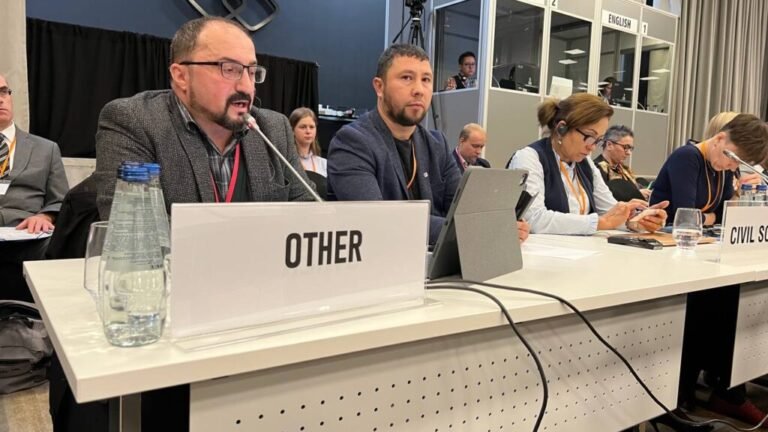
On October 4, at the 2nd plenary session of the Warsaw Conference on Human Dimension: Fundamental Freedoms I, participants discussed issues such as “Freedom of Opinion and Expression,” “Freedom of the Media,” and “Safety of Journalists.” At the session, Ilkhomjon Yokubov, a representative of the “Center Tajikistan for Human Rights,” delivered a speech. During his […]
On October 4, at the 2nd plenary session of the Warsaw Conference on Human Dimension: Fundamental Freedoms I, participants discussed issues such as “Freedom of Opinion and Expression,” “Freedom of the Media,” and “Safety of Journalists.”
At the session, Ilkhomjon Yokubov, a representative of the “Center Tajikistan for Human Rights,” delivered a speech. During his address, he emphasized that in recent years, the regime of Emomali Rahmon has imprisoned more than 30 journalists on political grounds.
According to Yokubov, in the past year alone, more than a dozen journalists were sentenced to long prison terms based on fabricated charges. Among them, Ulfatkhonim Mamadshoeva was sentenced to 21 years, Daleri Emomali to 10 years, and Abdullo Gurbati and Zavkibek Amini to 7 years of imprisonment.
Ilkhomjon Yokubov also added that previously, other journalists, such as Mahmadali Khait and others, were sentenced to life imprisonment, while Abdukakhkori Davlat, Rahmatullohi Rajab, Zubaidullohi Razikov, and Hikmatullo Saifullozoda received lengthy sentences ranging from 23 to 28 years of imprisonment.
As reported by the representative of the “Center Tajikistan for Human Rights,” arrests and persecutions continue in the country. For example, in the last 3 months, writer Abduhalil Kholikzoda and well-known journalist and writer Abdukodiri Rustam were detained.
“In the past 8 years, more than a hundred journalists have fled Tajikistan. In Tajikistan, one ‘like’ on social media can lead to a sentence of 5-10 years in prison. Hundreds of people have been convicted for ‘likes’ or comments on social media. Relatives of activists who criticize the regime from abroad, including women, the elderly, and even children, are detained and subjected to torture. For example, in the last five days, more than a hundred relatives of activists have been detained, and the fate of some of them remains unknown,” said Ilkhomjon Yokubov.
Giving an example from his own life, the representative of the “Center Tajikistan for Human Rights” reported that law enforcement agencies in Tajikistan have opened a criminal case against his parents, who are over 80 years old, as well as against his sister.
At the end of his speech, he called for pressure on the authorities of Tajikistan to stop persecuting journalists and to release political prisoners who are held in inhumane conditions in the regime’s prisons.
Earlier, on October 3, the head of the U.S. delegation at the Warsaw Conference on Human Dimension of the OSCE, Michael Kozak, stated that the United States is concerned about the increasing pressure on civil society in Tajikistan.
“We are deeply concerned that the government of Tajikistan is constantly exerting pressure on civil society, and since March 2022 has been forcing public organizations, especially in the Gorno-Badakhshan Autonomous Region, to announce their self-liquidation. We demand that the government of Tajikistan ensure that law enforcement agencies comply with the law, protect human rights, and fundamental freedoms of citizens,” said Michael Kozak.
Meanwhile, a special meeting on the topic of political prisoners in post-Soviet countries took place at the OSCE meeting. At the meeting, Marius Fossum, a representative of the Norwegian Helsinki Committee, raised the issue of political prisoners in Tajikistan and the current situation in the country. Fossum called on the authorities of Tajikistan to release political prisoners, stop detentions, and pressure on dissidents and their relatives. He also suggested adding Tajik officials involved in human rights violations to the “Magnitsky list” and imposing sanctions on them.