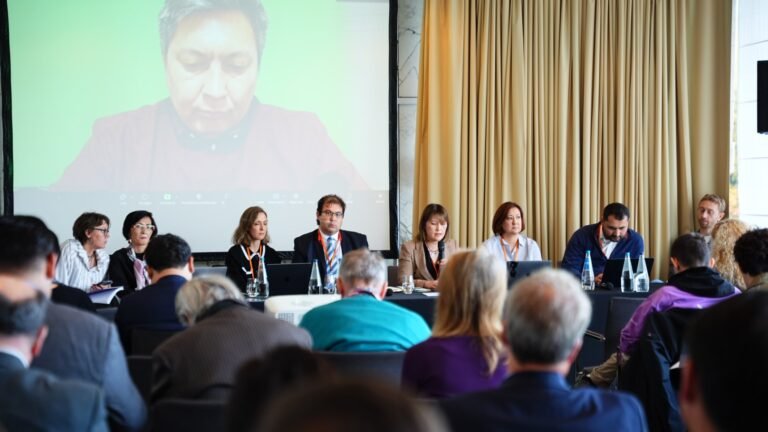
The situation with press freedom in Central Asia was discussed in Warsaw
Amid increasing pressure on independent media in Central Asian countries, international experts gathered in Warsaw to discuss the situation regarding press freedom, threats and issues, as well as measures to protect journalists. The meeting took place on October 9, 2025, in Warsaw, the capital of Poland, as part of the events of the Warsaw Human […]
AZDA.TV· Send to others
Photo: Internet
Amid increasing pressure on independent media in Central Asian countries, international experts gathered in Warsaw to discuss the situation regarding press freedom, threats and issues, as well as measures to protect journalists.
The meeting took place on October 9, 2025, in Warsaw, the capital of Poland, as part of the events of the Warsaw Human Dimension Conference, an annual event held under the Organization for Security and Co-operation in Europe. This event was organized by the ABA Center for Human Rights, the TrialWatch project of the Clooney Foundation for Justice, and the Committee to Protect Journalists (CPJ).
During the event, experts discussed various important issues, including the persecution of journalists and pressure on media, and proposed specific recommendations for protecting independent media and ensuring public access to reliable information.
Speakers included Mukhammadjon Kabirov, director of Azda.TV and human rights activist from Tajikistan; Rinat Tukhvatshin, co-founder of Kloop Media from Kyrgyzstan; Bolot Temirov, founder of Temirov Live; Bakhitjan Toregozhina, activist, head of Ar.Rukh.Khak and the Qantar 2022 coalition from Kazakhstan; and Umida Niyazova, director of the Uzbek Forum for Human Rights from Uzbekistan.
The meeting was moderated by Jasmine Cameron, senior legal advisor at the ABA Center for Human Rights. Opening remarks were made by Kate Levin, a lawyer at the Clooney Foundation for Justice, and Nick Lewis, CPJ correspondent for Central Asia and the Caucasus.
Experts emphasized that criminal prosecutions, pressure, and restrictive laws in the region create a “chilling effect” that hinders independent journalists from conducting independent investigations and limits public access to reliable information.
Participants of the event called on OSCE member states and civil society to take serious steps to protect journalists and strengthen the role of independent media in society as an important element of democracy.