Two years after the harsh suppression of protests in Tajikistan: here is what society has lost from the expulsion of media from the country
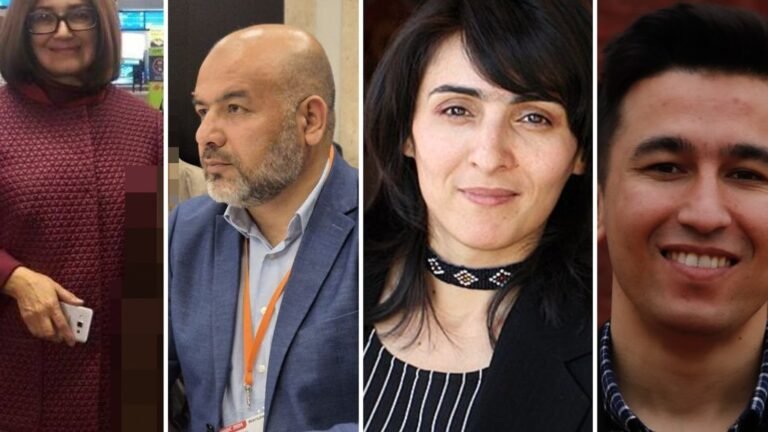
From left to right, Tajik journalists Ulfatkhonim Mamadshoeva, Shavkat Muhammad, Anora Sarkorova, Abdullo GurbatiPhoto: Erika Di Benedetto (OCCRP) Muhammadjon Kabirov (Azda TV) and Firuzi Mahmadali (Azda TV) In this Central Asian country with a repressive regime, journalists have always found it difficult to work. However, the harsh measures against peaceful protesters have exacerbated an already […]
AZDA.TV· Send to others
Photo: Internet
From left to right, Tajik journalists Ulfatkhonim Mamadshoeva, Shavkat Muhammad, Anora Sarkorova, Abdullo Gurbati Photo: Erika Di Benedetto (OCCRP)
Muhammadjon Kabirov (Azda TV) and Firuzi Mahmadali (Azda TV)
In this Central Asian country with a repressive regime, journalists have always found it difficult to work. However, the harsh measures against peaceful protesters have exacerbated an already difficult situation, resulting in some journalists ending up in prison while others fled abroad.
In Tajikistan, pressure on independent journalism is constantly increasing. The last wave of local reporting occurred in the spring of 2022.
It was then that Tajikistan’s security forces brutally suppressed protests in the Gorno-Badakhshan Autonomous Region, home to the Pamiri people, a large ethnic minority.
After a local youth leader died in police custody, residents increasingly took to the streets demanding justice. But Tajik authorities conducted a so-called anti-terrorist operation: the crowd was dispersed using tear gas and rubber bullets. About forty people were killed, and 200 were detained and tortured.
Local reporters, bloggers, and activists reported on how the protests were suppressed, sharing photos and videos of the violence and its aftermath. When the authorities shut down the internet in the Gorno-Badakhshan Autonomous Region, information began to be transmitted by Tajik journalists working abroad. They published dozens of images and eyewitness accounts of how protesters were killed and that security forces were responsible for it.
Photo: Internet
The city of Khorog in the Gorno-Badakhshan Autonomous Region of Tajikistan, where protests took place. Photo: Andrei Khorobostov / Alamy Stock Photo
“The Tajik authorities saw in GBAO (Gorno-Badakhshan Autonomous Region) with its local informal leaders and civil society a region that is not fully under government control,” said Marius Fossum, a Central Asia expert from the Norwegian Helsinki Committee. “The authorities tried to eradicate this sense of autonomy and independence.”
The consequence of the repression has been the near-total disappearance of independent journalists within the country. For covering the protests, at least six journalists and information gatherers were sentenced to long prison terms ranging from 7 to 21 years. Many others chose to leave the country to join their colleagues working abroad, who lack sources of information, while readers in Tajikistan have almost nowhere to find reliable news about unemployment, electricity consumption restrictions, and the impending transition of power.
“When a journalist is in the country, they have the opportunity to communicate with people personally, observe events, and draw conclusions based on direct experience,” said journalist Shavkat Muhammad, who fled Tajikistan in 2015. He now works for the online news service Payom TV in Europe. “Covering events from abroad is much more difficult.”
Suppression of Dissent
The President of Tajikistan, Emomali Rahmon, has long and consistently sought to control the media and combat independent journalism.
Photo: Internet
President of Tajikistan Emomali Rahmon. Photo: Kremlin.ru
Once, the country had a relatively healthy media environment: independent newspapers such as “Najot” (Tajik for “Salvation”) and “Nigoht” (Tajik for “View”) complemented reports from non-governmental news agencies “Ozodagon” and TojNews.
Emomali Rahmon has been in power for over thirty years, during which he has amassed enormous wealth and political power. Pressure on independent media in the country intensified after a large-scale crackdown on political opposition in 2015.
Prominent journalists, such as the editor-in-chief of “Najot” Hikmatullo Saifullozoda and Abdukahhor Davlat, who publishes on the popular site Nahzad, were arrested and sentenced to long prison terms.
Many editorial offices were forced to close or relocate from the country. Leading the movement of Tajik journalists abroad are projects such as Bombod.com, Isloh.tv, and Azda.tv, which collaborated with OCCRP.
However, independent voices are still heard in remote areas such as the Gorno-Badakhshan Autonomous Region. One Tajik journalist who fled to Berlin due to persecution related to protests said that journalists and activists in this region criticize the government more openly than their colleagues in Dushanbe.
According to him, Tajik officials are preoccupied with the long-awaited power transition, and the loud protests in GBAO are seen as a threat to the authorities’ statements about national unity.
“This protest created a precedent that could spread to other regions where there are protest sentiments,” said the journalist, who requested anonymity for security reasons. “Repressive measures in GBAO have signaled to other regions what will happen to those who dare to challenge the current regime.”
The most well-known of the reporters arrested during the protests in GBAO was Ulfatkhanim Mamadshoeva, an activist and former journalism teacher at a university in Dushanbe. Following a closed trial, Mamadshoeva was sentenced to 21 years in prison.
Photo: Internet
Ulfatkhonim Mamadshoeva. Photo: Screenshot of a Facebook post published by Ulfatkhonim Mamadshoeva
Other journalists, including bloggers and videographers, are serving sentences ranging from 7 to 11 years. Some, like Mamadshoeva, are already over 60, while others are still quite young. Abdullo Gurbati, for example, is not yet twenty. The journalist and documentary filmmaker was sentenced to seven and a half years in prison.
Photo: Internet
Journalist Abdullo Gurbati. Photo: Screenshot of a Facebook post published by Ulfatkhonim Mamadshoeva
Criminal charges have even been brought against journalists who reported on protests from abroad. Anora Sarkorova, a former BBC reporter and native of the Gorno-Badakhshan Autonomous Region living in Europe, has continuously published photos and information about the use of repressive measures on social media thanks to her connections.
Almost two years later, she learned that she and her husband Rustamjon Joniyev, also a journalist, were charged with inciting “extremist activities” for their work.
Sarkorova was informed of the charges by her mother, who still lives in Tajikistan: police had visited her. According to Amnesty International, the couple’s relatives received threats and were subjected to interrogations — through them, the authorities tried to influence the journalists.
However, Sarkorova remains unyielding. “We will not apologize for writing about mass human rights violations, killings, torture, and rapes in Tajikistan,” she wrote on her Facebook page.
Photo: Internet
Anora Sarkorova. Photo: Screenshot of a Facebook post published by Anora Sarkorova
Fossum from the Norwegian Helsinki Committee claims that attempts to silence independent voices in the country and beyond hinder vital dialogue between citizens and the government, which could lead to even greater unrest.
“The authorities have deprived the population of legitimate ways to express discontent, but that does not mean that problems and dissatisfaction will disappear,” he said. “The authorities do not know what is happening among the population and are cutting themselves off from the sentiments of the people. This is very dangerous.”
“It is difficult to convey from a distance”
For most residents of Tajikistan, the information landscape is becoming increasingly barren. International news occasionally reports on corruption at the highest levels of power and that Rahmon is transferring power to his son Rustam Emomali. But within the country, survival becomes the primary concern.
The country is facing months of cold winter, and many residents receive electricity for only 10 hours a day: in October, power supply restrictions were introduced. The unemployment rate is rising: labor migrants were mass deported from Moscow after the March terrorist attacks carried out by Tajik militants. Many Tajik families depend on the money sent by seasonal workers. Now they cannot even afford basic necessities.
Payom TV journalist Muhammad reported that he had to reduce the volume of news due to difficulties in finding reliable sources: many of them have gone underground.
“When you work remotely, the information you receive must be current and reliable,” he said. “You cannot spread rumors or distorted data.”
Photo: Internet
Journalist Shavkati Muhammad. Photo: Payom TV
And although working abroad gives journalists freedom of speech, the lack of direct access to events comes at a high cost. “Often, personal contact with sources is much more effective,” he says. “It’s easier to understand the context and emotions. It’s hard to convey that from a distance.”
Observers of press activities are concerned: journalists have limited access to audiences and sources of information, while the cost of living in Europe continues to rise. As a result, media workers forced to leave their home countries may simply disappear.
The Committee to Protect Journalists (CPJ), which has gathered resources for journalists forced to leave their homeland, notes that many leave their countries due to traumatic circumstances, and it may take them years to recover from these events.
Many decide to completely change professions: According to CPJ, only 20 percent of journalists who received assistance from the organization continue to work in journalism after moving abroad.
Gulnoza Said, who monitors events in Europe and Central Asia for CPJ, believes that journalists in Tajikistan face a serious choice. “Go to prison for many years or leave the country. And unfortunately, compared to journalists leaving countries like Russia and Belarus, Tajik journalists receive much less attention abroad,” she noted.