USCIRF called for sanctions against Tajik officials and government agencies
The U.S. Commission on International Religious Freedom has called on U.S. authorities to impose sanctions against a number of officials and government agencies in Tajikistan for serious violations of residents’ rights. In its latest report for 2023, the U.S. Commission on International Religious Freedom (USCIRF) included Tajikistan in the list of countries of “particular concern” […]
AZDA.TV· Send to others
Photo: Internet
The U.S. Commission on International Religious Freedom has called on U.S. authorities to impose sanctions against a number of officials and government agencies in Tajikistan for serious violations of residents’ rights.
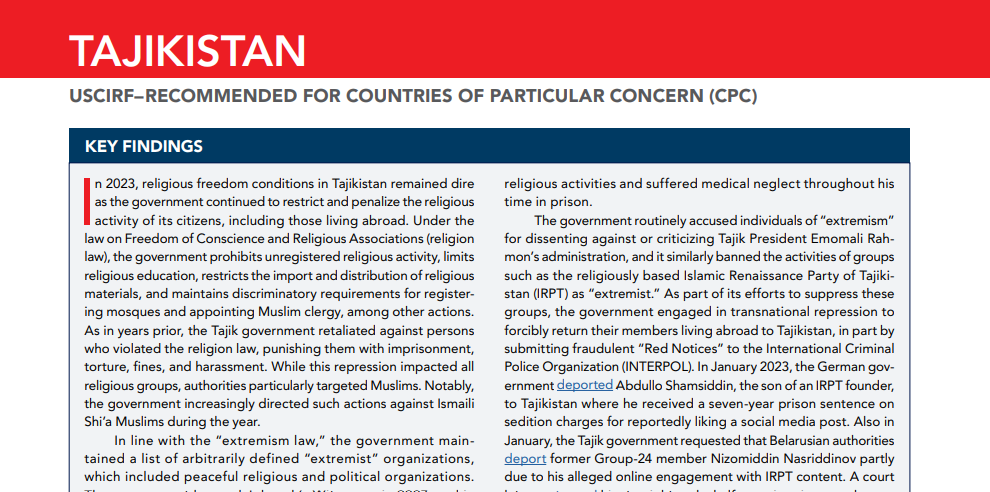
In its latest report for 2023, the U.S. Commission on International Religious Freedom (USCIRF) included Tajikistan in the list of countries of “particular concern” for systematic and particularly severe violations of the right of residents to freedom of religion or belief.
This list also includes 12 countries that the State Department designated as “countries of particular concern” in December 2023, including Burma, China, Cuba, Eritrea, Iran, Nicaragua, North Korea, Pakistan, Russia, Saudi Arabia, and Turkmenistan, as well as five additional countries, including Afghanistan, Azerbaijan, India, Nigeria, and Vietnam.
“In 2023, conditions for freedom of religion in Tajikistan remained dire, as the government continued to restrict and punish the religious activities of its citizens, including those living abroad,” the report states.
Photo: Internet
The authors of the report emphasized that the government of Tajikistan prohibits unregistered religious activities, restricts religious education, limits the import and distribution of religious materials, and maintains discriminatory requirements for the registration of mosques and the appointment of Muslim clergy.
The U.S. Commission on International Religious Freedom notes that the government of Tajikistan, as in previous years, has taken retaliatory measures against individuals who violated the law on religion, punishing them with imprisonment, torture, fines, and persecution.
The report particularly highlighted that authorities frequently persecuted Muslims, noting that last year the government increasingly targeted Ismaili Shia Muslims. The government also persecuted Jehovah’s Witnesses.
The government regularly accused individuals of “extremism” for dissent or criticism of President Emomali Rahmon’s administration and has initiated transnational repressions aimed at forcibly returning abroad members of the Islamic Renaissance Party of Tajikistan (IRPT) to Tajikistan, including through Interpol notices, the report states.
“In January 2023, the German government deported Abdullo Shamsiddin, the son of the founder of the PIVT, to Tajikistan, where he was sentenced to seven years in prison on charges of inciting rebellion for allegedly liking a post on social media. Also in January, the Tajik government requested the Belarusian authorities to deport former member of the ‘Group 24’ Nizomidin Nasriddinov. Later, the court sentenced him to eight and a half years of imprisonment for attempting to violently change the constitutional order of Tajikistan,” writes the U.S. Commission on International Religious Freedom.
The authors of the report also stated that the authorities closed or destroyed mosques in localities that did not provide a sufficient number of servicemen for the army in Isfara and Vahdat.
In its report, the U.S. Commission on International Religious Freedom called on U.S. authorities to condition the Tajik government on reforming the 2009 religion law, thereby improving conditions for freedom of religion or belief, as well as to train Tajik officials on issues of religious freedom.
The commission also recommended imposing targeted sanctions against government institutions and officials in Tajikistan responsible for serious violations of religious freedom by freezing the assets of these individuals and banning them from entering the U.S.
The Tajik authorities have not yet responded to the report of the U.S. Commission; however, earlier, the Committee on Religious Affairs of Tajikistan stated that “not all data in the reports corresponds to reality.”