News
CENTRAL ASIA POLITICS
What did Cameron propose to the Central Asian countries?
The British Foreign Secretary was adamant. London – and the West, accordingly – are not seeking exclusive relationships. They simply want to offer options for Central Asia, aside from Russia and China. During his brief visit to Kazakhstan, British Foreign Secretary David Cameron was firm on one issue. Cameron insists that he is not asking […]
The British Foreign Secretary was adamant. London – and the West, accordingly – are not seeking exclusive relationships. They simply want to offer options for Central Asia, aside from Russia and China.
During his brief visit to Kazakhstan, British Foreign Secretary David Cameron was firm on one issue. Cameron insists that he is not asking Kazakhstan or any of the Central Asian countries he just visited to choose between the West or its other key partners, Russia and China. “We are not telling Kazakhstan or any other country that you have to make a choice,” he said, emphatically emphasizing those last three words. “We are here because we believe you should have the ability to choose and engage with us in a way that is beneficial for both our security and our prosperity.” He expressed the same sentiment, akin to a mantra, repeatedly over the course of several days. This diplomatic rhetoric is supposedly aimed at easing the irritation of a region that fears being viewed as a prize in a 19th-century style geopolitical competition. And this is for the better, as examining the underlying economic data does not evoke a sense of competition.
Last year, the trade volume between China and Kazakhstan amounted to $31.5 billion. Russia shares a 7,600-kilometer border with its southern neighbor, a member of the Eurasian Economic Union (EAEU). Unsurprisingly, they earned $26 billion from trade. If you look at the list of Central Asian countries, you can see roughly similar patterns. Additionally, there is the issue that Kazakhstan, Kyrgyzstan, and Tajikistan are members of the Moscow-led Collective Security Treaty Organization – a sort of troubled mini-NATO. It is tempting to view Europeans and even Americans as secondary players. But the West approaches its commitments in the region much like Archimedes with his lever. It believes that by directing energy in a measured way, enormous results can be achieved.
The financial military chest announced by Cameron when he arrived in the region was definitely very small. His office reported that he would announce “new funding of £50 million ($62 million) to support the sovereignty and independence of states across the region.”
Tajikistan, the Foreign Secretary’s first stop, turned out to be a matter of chance when he blinked and missed it. The main outcome was a preliminary, non-binding agreement to establish a direct air route. The thoughts of Tajik President Emomali Rahmon were likely more occupied with his trip to Italy later that same day.
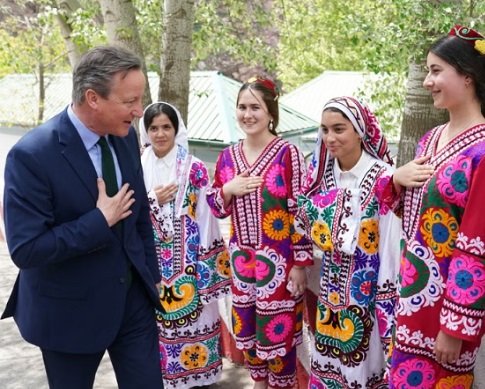
The Kyrgyz segment of the meat tour was slightly larger. A cornerstone document was the roadmap for bilateral cooperation for 2024–2026. The Minister of Foreign Affairs of Kyrgyzstan, Jeenbek Kulubaev, suggested to the visiting delegation to consider what investments could be made in the development of rare earth metal reserves and the transition to green energy. The British ambassador in Bishkek was thrilled. “Wow,” he wrote on his X account. “One visit, and [Kyrgyz-British] bilateral relations are taken to another level.” He then listed the results: trade deals worth £180 million were concluded; the number of available Chevening scholarships was doubled (this is happening across the region); Anglo-Kyrgyz textbooks were offered to every school in Kyrgyzstan; and the “commitment to civil society and independent media” was renewed. The government of Kyrgyzstan has recently shown less enthusiasm towards civil society and independent media, judging by how many representatives of these communities it has detained behind bars over the past couple of years, but this detail apparently did not dampen the mood.
During Cameron’s introductory tour in Uzbekistan, a couple of key documents were adopted: a Memorandum of Understanding on regional and international relations and infrastructure, and a Joint Declaration on comprehensive cooperation. Anyone familiar with Britain’s far from outstanding recent achievements in railway construction would raise an ironic smile upon seeing the memorandum of understanding that provides for British support for the development of new high-speed rail projects in Uzbekistan. A cynic might argue that aid should go in the other direction. The President of Uzbekistan, Shavkat Mirziyoyev, decided to take a short vacation before Cameron’s arrival, which seemed quite dismissive. He was the only leader in the region who avoided meeting with the visiting Foreign Secretary. In Uzbekistan, as he did in Kyrgyzstan and will continue to do in Kazakhstan, Cameron emphasized that the UK does not want Central Asian countries to reject any partners.
The British involvement in the region is most prominently manifested in Kazakhstan. The agreement on strategic partnership and cooperation, signed during Cameron’s visit, is so extensive that it spans three volumes. “I am confident that this comprehensive document will lay a qualitatively new foundation for the expansion of our multifaceted bilateral agenda,” said Kazakhstan’s President Kassym-Jomart Tokayev during a meeting with Cameron. The UK is particularly eager to convince Kazakhstan of the attractiveness of its education system. Earlier this year, Almaty’s Narxoz University and Queen’s University Belfast joined forces to create a dual degree program. There are also plans to open Kazakh language courses at the University of Oxford. However, to confirm that Tokayev takes Cameron’s remarks about strategic non-exclusivity at face value, the next day he met with Chinese Defense Minister Dong Jun. He notably remarked that Kazakhstan and China are bound by an “eternal comprehensive strategic partnership,” which casts a shadow over the UK-Kazakhstan strategic partnership.
Cameron’s tour of Central Asia concluded in Turkmenistan. His meeting with President Serdar Berdymukhamedov was covered by Turkmen state television in a characteristically restrained manner. A somewhat more dynamic clip was published on X, in which Cameron was filmed on a windswept hill overlooking Ashgabat, explaining once again that Central Asia is “sandwiched between China, Russia, Afghanistan… and Iran.”
The purpose of this video was to emphasize that while the UK may have ignored this region in the past, the situation is changing. “Why are we here now?” he rhetorically asked. “Well, perhaps we should have done more in the past, but we are here now because they [the Central Asian countries] are necessary for British security and British prosperity.”
PETER LEONARD, APRIL 25 (havli.sunstack.com)