Mass protests took place in Georgia against the “foreign agents” law. Photo: Internet On March 7 and 8, mass protests took place in the capital of Georgia, Tbilisi. The demonstrations were sparked by the Georgian parliament’s first reading of a controversial bill on “foreign agents.” Protesters believe that the law is copied from Russia’s legislation, […]
AZDA.TV· Send to others
Mass protests took place in Georgia against the “foreign agents” law.
Photo: Internet
On March 7 and 8, mass protests took place in the capital of Georgia, Tbilisi. The demonstrations were sparked by the Georgian parliament’s first reading of a controversial bill on “foreign agents.”
Protesters believe that the law is copied from Russia’s legislation, and the adoption of this law will lead to a large number of political figures and activists being imprisoned, just as Russia has used it for ten years to suppress its opponents.
According to Georgian media, thousands of protesters gathered in front of the parliament building in Tbilisi, raised flags of Georgia, the European Union, and Ukraine, and blocked the central avenue. The protesters chanted “No to the Russian law!” and other anti-Russian slogans.
Law enforcement used tear gas and water cannons to disperse the protesters in front of the parliament building. Protesters threw “Molotov cocktails” and stones at the police. As a result, clashes broke out between law enforcement and protesters, with dozens of people injured. It was also reported that the police used rubber bullets.
According to media reports, the police detained more than 66 protesters, including opposition leaders.
The opposition, in turn, stated that they would continue protests in front of the Georgian government building on March 8.
At the end of February, deputies from the “People’s Power” movement, which residents consider anti-Western, proposed two bills for consideration: “On Transparency of Foreign Influence” and “On Registration of Foreign Agents.”
According to the law, a non-commercial legal entity that receives more than 20 percent of its funding from foreign sources is registered as a foreign influence agent. Otherwise, it faces fines. The Georgian opposition believes that the law is aimed at restricting the activities of human rights defenders and the press and is incompatible with the country’s European integration.
In Russia, the law on foreign agents was adopted in 2012 and is still used to suppress the opposition.
On Tuesday evening, the bill was passed in its first reading in the country’s parliament. It is expected that the parliament will adopt this law in the second and third readings, as it is supported by the ruling party “Georgian Dream.”
Georgian Prime Minister Irakli Garibashvili stated that he supports the “foreign agents” law. According to him, “many” non-governmental organizations “directly fight against statehood, the interests of the state.” At the same time, he claimed to be leading “the country on the path of European integration.”
However, Georgian President Salome Zourabichvili criticized the authorities and the country’s parliament.
“The authorities must realize that they have one last chance to bridge the growing gap with society. They have one last chance to show that they are not a pro-Russian force,” she stated.
The European Union called the adoption of the “foreign agents” law a very bad development for Georgia and its people, as this law is incompatible with the values and standards of the European Union and may hinder Georgia’s accession to the European Union.
The U.S. Embassy in Georgia called the day of the first reading of the “foreign agents” bill in the Georgian parliament a “black day for Georgian democracy.”
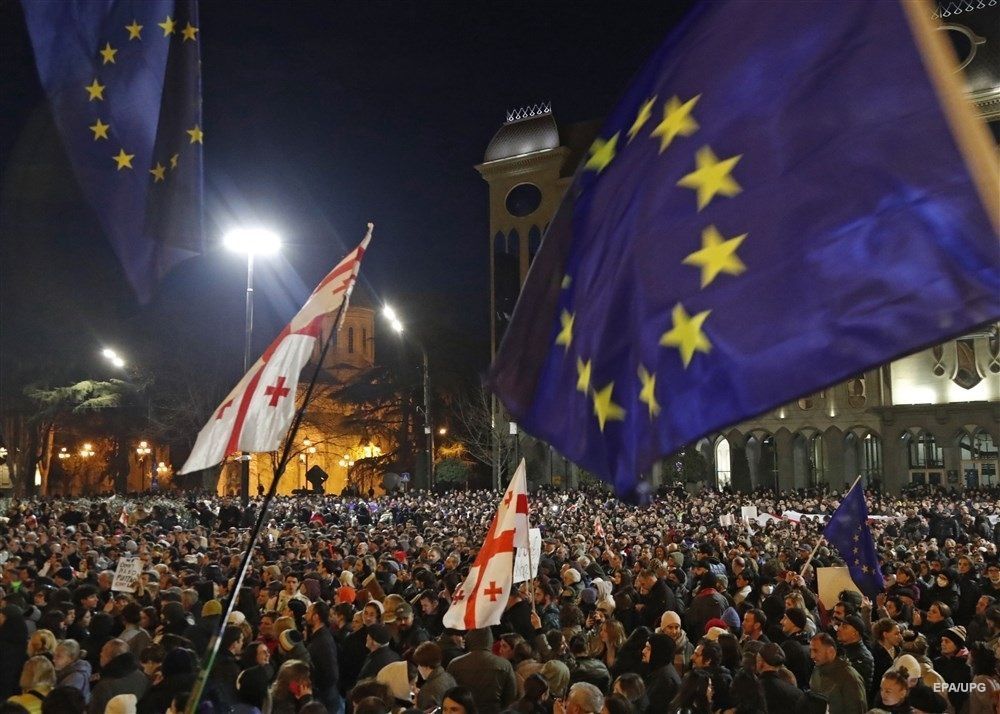 Photo: Internet