News
POLITICS
Who benefited from the deal at the Tajik-Kyrgyz border?
The authorities of Kyrgyzstan have revealed some details of the border agreement between Tajikistan and Kyrgyzstan. On February 27, during a joint meeting of the committees of the Jogorku Kenesh (parliament) of Kyrgyzstan, the head of the State National Security Committee Kamchybek Tashiev shared some details about the agreements regarding the Tajik-Kyrgyz state border. The […]
The authorities of Kyrgyzstan have revealed some details of the border agreement between Tajikistan and Kyrgyzstan.
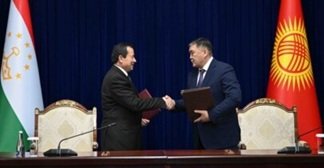
On February 27, during a joint meeting of the committees of the Jogorku Kenesh (parliament) of Kyrgyzstan, the head of the State National Security Committee Kamchybek Tashiev shared some details about the agreements regarding the Tajik-Kyrgyz state border. The editorial team of 24.kg has compiled the main points from his speech and other known facts at this time.
Tashiev stated that previously, materials related to the borders with Tajikistan were not discussed publicly, as they were classified as “for official use only,” due to the possibility of various interpretations that could affect the outcome. However, now that the agreement has been reached and signed, the materials will be discussed openly.
Tashiev noted that the authorities of Tajikistan agreed to describe the border areas with Kyrgyzstan according to documents from 1991, rather than from 1924-1927.
The total length of the Kyrgyz-Tajik border is 1006.84 kilometers, of which 519.9 kilometers were clarified by 2011, and 486.94 kilometers were defined in the last three years, Tashiev stated.
According to him, in 2011, Tajikistan proposed to sign an agreement on 519.9 kilometers of the border, but Kyrgyzstan refused, demanding complete delimitation due to conflicts. Previously, negotiations were based on documents from 1924-1927, but Bishkek insisted on using materials from 1991, including the agreement on the establishment of the CIS.
Disagreements hindered progress: from 2011 to 2021, the parties could not agree on any section of the border.
As of February 27, the classification “for official use only” is lifted from the materials regarding the delimitation and demarcation of the Kyrgyz-Tajik border. Previously, the documents had the status of “restricted” due to possible discrepancies that could affect the negotiation process.
According to him, the total length of the Kyrgyz-Tajik border is 1006.84 kilometers, and the process of defining and marking it began in 2002. However, by 2011, only 519.9 kilometers had been defined, and after the Tajik side, 486.94 kilometers were defined only in the last three years.
“We received 190, gave away 190. The Leilek people know… We gave away small sections and conducted an exchange. If you ask what land is 12.5 hectares in Proletarsk? In the middle of Proletarsk during the Soviet era, there was an organization called Selkhozkhimia or Selkhoztekhnika, which had a 12.5-hectare plot. But this plot was sold. We returned this land. If we had kept silent, no one would have noticed. But we returned this land. Also, below Ak-Aryk. There was 7 hectares of land that our people never visited or used. Tajiks used these places. But we counted this land as ours,” Tashiev stated.
Additionally, 91 hectares of land from the village of Dostuk in the Batken region, Mazaite (8.3 hectares), the village of Kok-Terek (17.5 hectares), Tash-Tumshuk (20.1 hectares), and a plot in Dacha (5 hectares) were transferred to Tajikistan. The total area of the transferred land is 141.9 hectares.
In return, Kyrgyzstan received the village of Somoniyon in the Isfara district (18.4 hectares), the Dakhma plot (3.1 hectares), part of the village of Khojai Allo (21.5 hectares), the Govsuvor plot (2.7 hectares), the Min-Bulak plot (42 hectares with a garden), and part of the Lakkon plot (55 hectares). A total of 142.7 hectares.
Kamchybek Tashiev, commenting on the transfer of the village of Dostuk in the Batken region to Tajikistan, noted that it brings “neither economic nor strategic benefit,” and nevertheless, as compensation, Kyrgyzstan received 30 hectares of land.
Tajikistan also received the roads Khujand–Arka–Kanibadam and the “Dostuk” market, totaling 12 hectares. In return, Kyrgyzstan received 25 hectares of land.
Previously, negotiations on the Kyrgyz-Tajik border were suspended for six months due to a dispute over a 20-meter bridge in the area of the Tort-Kocho plot, located at the intersection of the Osh–Razakov and Isfara–Vorukh roads.
According to the head of the State National Security Committee of Kyrgyzstan, Kamchybek Tashiev, the plot for the construction of the bridge was previously allocated by the Tajik side; however, the bridge was built by Kyrgyzstan. As a result, the bridge remains with Kyrgyzstan. “This bridge is important for us from a strategic point of view, as all our residents – both from the Leilek and Batken districts – use this bridge,” Tashiev noted.
Kyrgyzstan and Tajikistan agreed to construct the Dacha–Kapchigay (Khojai-A’lo–Vorukh) road, with a length of 3425 meters, and the Min-Oruk–Samarkandek (Oriyon–Shuriston) road, with a length of 3241 meters, and these routes will also be assigned a neutral status.
The parties also resolved the issue of the “Golovnoy” water intake, which has repeatedly caused conflicts between Kyrgyzstan and Tajikistan. According to the agreements reached, each side received ownership of exactly half of the three gates of the water distribution facility on the Isfara River.