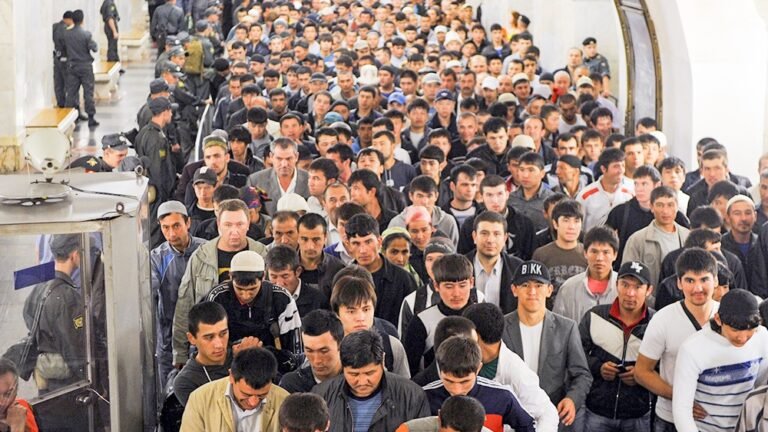
As Russia faces an increasing demand for labor, driven by various factors including the war in Ukraine, it seems that not a month goes by without the authorities imposing new restrictions on migrants or at least displaying hostility towards them, particularly those from Central Asia. What is the reason behind Russia’s changing attitude towards Central Asian migrants, and what consequences might this have?
Before discussing the reasons and consequences, it is important to briefly review the recent actions taken by the authorities against migrants. Previously, law enforcement focused on administrative measures, occasional checks, and raids, but recently there has been a significant shift in legislation, limiting civil rights and leading to mass cancellations of residency documents.
Recently, Russian authorities have implemented a series of reforms that severely restrict the stay and employment of migrants in the country:
a) For those whose documents have expired or who have violated residency rules, a special legal regime has been introduced. Individuals on this list lose almost all civil and financial rights: they can no longer purchase real estate or vehicles, obtain a driver’s license, open a bank account, transfer money, or even get married.
b) A new law has linked the acquisition of Russian citizenship to military registration. Failure to register with the military within certain deadlines becomes a primary reason for citizenship cancellation and subsequent deportation from the country.
c) More than half of the regions in the country, including the Moscow region, Novosibirsk, Kaluga, Tyumen, and others, have completely banned the activities of labor migrants in key sectors such as taxi services, public transport, retail, education, and food services.
d) The process of undergoing all medical examinations, as well as fingerprinting and photographing, has been transferred to the migrants’ countries of origin, including Tajikistan. A controlled recruitment of labor migrants has been introduced under strict police oversight.
The issue extends beyond restrictions. Russian politicians, through their hostile and anti-migrant statements, are intensifying anti-migrant sentiments in the country, and the number of such hostile and controversial politicians is increasing year by year. It is likely that in the upcoming parliamentary elections for the State Duma, more candidates will begin to campaign with anti-migrant slogans, resulting in a greater number of such deputies.
Here are a few examples of anti-migrant politicians in Russia:
Sergey Mironov, a State Duma deputy and head of the “Fair Russia – For Truth” faction, is the number one enemy of migrants in the Russian parliament. He is one of the main authors and initiators of tightening migration policies and often proposes radical measures. For instance, he has repeatedly suggested imposing a complete moratorium on the entry of migrants from Central Asian countries and establishing a visa regime with Tajikistan and Uzbekistan.
In one of his well-known statements, Mironov said: “A migrant should work on the principle of ‘arrived, worked, left; no families, wives, or children, no pensions or social benefits at the expense of Russian taxpayers should be allowed.'” He also proposed that in the event of a migrant committing an offense, not only the individual but their entire family should be deported.
Another anti-migrant politician is Alexander Bastrykin, head of the Investigative Committee of the Russian Federation. He actively speaks out against migrants, viewing them as a primary source of crime. For example, at the International Youth Legal Forum in St. Petersburg, he criticized the weakness of deputies in passing migration laws, stating: “I would really like to know when our State Duma will adopt good laws.”
In one of his speeches, Bastrykin openly stated that authorities had registered over 30,000 former migrants who had obtained Russian citizenship for military service, with thousands sent to the front lines to dig trenches and serve in combat zones. He described this method as a new “trick” to force migrants to flee Russia.
Deputy Chairman of the State Duma Pyotr Tolstoy holds such Nazi-like views that mass migration threatens the “Russian world” and the cultural fabric of the country, calling for the cessation of diaspora activities as “parallel structures of power.”
Chairman of the Duma Vyacheslav Volodin asserts that migration legislation should not only be tightened but made as strict as possible.
However, why have the authorities turned against migrants when Russia needs labor migrants, and migrants from Central Asia, including Tajiks, have a certain level of proficiency in the Russian language, are familiar with Russian culture, and have decades of work experience in the country?
It appears that the Russian authorities, due to political goals and security concerns, are ignoring the economic benefits. The reasons and factors that seem to compel Russia to adopt anti-migrant initiativesâspecifically those targeting Central Asian migrantsâare rooted in politics and security issues.
One of the main reasons is religion. In addition to the 3 million Tajiks currently living in Russia, at least half of whom already have Russian citizenship, there are nearly 5 million natives of Uzbekistan and 1.5 million natives of Kyrgyzstan in the country.
Russian authorities and law enforcement agencies (FSB, Ministry of Internal Affairs) believe that migrants from Central Asia, instead of assimilating into Russian society, are creating diasporas and ethnic enclaves.
They arrive, bring their families, enroll their children in local schools, and form distinct neighborhoods. In the eyes of Kremlin politicians, this process alters the demographic, religious, and cultural structure of the country. While the population of Muslim regions in Russiaâsuch as the Caucasus, Tatarstan, and Bashkortostanâis growing (as Muslim families tend to have more children), the number of Muslims in the country increases with the acquisition of Russian citizenship by Central Asian natives, while the proportion of ethnic Russians decreases. With this dynamic, Muslims could become the majority in the country within a few decades. Given the high level of xenophobia in Russia, this process greatly alarms them.
Another reason is the weak control, which is a key factor in the strengthening of diasporas and ethnic groups. Migrants from Central Asia, thanks to the visa-free regime and decades of experience in Russia, have operated very “freely”: they could change employers, obtain patents, process documents, and work independently. To prevent uncontrolled consequences, Russian authorities want to restrict this “freedom” as much as possible. One reason why Russian authorities are attracting labor migrants from India and Sri Lanka is precisely this. They are subjected to methods used in Gulf countriesâso-called “sponsorship.” This means that each migrant already has a specific job and place of residence before arriving in the country and is under full control.
Another reason is that largely defenseless migrants from Central Asia are used as scapegoats. In times of war, sanctions, and economic problems, governments always need internal enemies to divert public attention from major issues. For politicians like Mironov or Bastrykin, the migration issue is the easiest way to earn political points and boost their ratings among the local population.
Additionally, Russian authorities may use this pressure to recruit as many labor migrants as possible for the war in Ukraine. With the tightening of legislation, some migrants find themselves faced with a choice: go to war or return home without money, in debt, to their half-starved wives and children.
It seems that migrants must abandon the hope that things will return to the way they were and fight for their futureâwhether that future involves staying in Russia, returning home, or choosing another country for work.