News
CENTRAL ASIA WORLD
Will Central Asian countries switch to a unified alphabet?
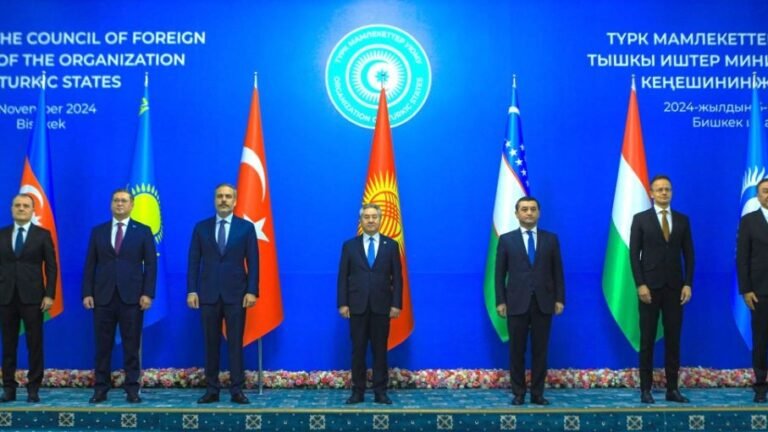
At the meeting of the Organization of Turkic States, a proposal was made to switch to a unified Turkic alphabet. On November 6, at the meeting of the heads of state participating in the Organization of Turkic States (OTS) in Bishkek, Turkish President Recep Tayyip Erdoğan raised the issue of transitioning to a unified Turkic […]
At the meeting of the Organization of Turkic States, a proposal was made to switch to a unified Turkic alphabet.
On November 6, at the meeting of the heads of state participating in the Organization of Turkic States (OTS) in Bishkek, Turkish President Recep Tayyip Erdoğan raised the issue of transitioning to a unified Turkic alphabet.
In his speech, Recep Tayyip Erdoğan stated that “a common alphabet for Turkic states will take us and our destiny a step forward.”
Erdoğan noted that Turkey, Azerbaijan, and Northern Cyprus are already ready to switch to a unified Turkic alphabet, and now it is the turn of Kazakhstan, Kyrgyzstan, Uzbekistan, and Turkmenistan.
At the same time, experts believe that the transition of Kazakhstan, Kyrgyzstan, and Uzbekistan to a unified Turkic alphabet may be problematic due to Russia’s influence.
The commission of the Organization of Turkic States had already approved a previously developed unified alphabet in Latin script, consisting of 34 letters, in September. This event was described as “historic” at the organization’s meeting in Bishkek.
The Organization of Turkic States was founded in 2009. Its members include Azerbaijan, Kazakhstan, Kyrgyzstan, Turkey, and Uzbekistan. Hungary, Northern Cyprus, and Turkmenistan currently hold observer status in the Organization of Turkic States.
Previously, Turkey also proposed to rename Central Asia. Thus, fundamental changes were introduced to the Turkish school curriculum in history. According to the new approach, the term “Central Asia” will be replaced with “Turkestan.” The changes were supported by the country’s president, Recep Tayyip Erdoğan.
Tajik experts believe that this process threatens the national and linguistic identity of Tajiks and Persian-speaking residents who remain among Turkic-speaking countries. Recently, in academic circles of Turkic-speaking countries in Central Asia, many scholars and historical achievements of Tajiks have been attributed to the Turks, raising concerns among Tajik and Persian-speaking scholars in the region.